Dawn on the Buriganga. A wooden ferry noses out of the mist, a rickshaw bell rings on the embankment, and someone is already frying something that smells like cumin and onions. A few days from now you could be rowing through a flooded forest, walking a tea garden at sunrise, or standing in a brick monastery older than most European cathedrals. Bangladesh is a crowded, loud, generous country, and it rewards travelers who arrive with a plan.
At Roam Bengal, we meet visitors at Dhaka airport every week. This guide is the one we wish every first-timer had read: the visa, the seasons, the regions, the money, the manners, and an honest look at safety. Use it as your map, then dig into the detailed guides linked at the end.
🌿 Why Visit Bangladesh
Bangladesh is a river delta, and the rivers shape everything: the food, the roads, the festivals, the way people live. You can spend a morning in a UNESCO World Heritage Site mangrove forest and an afternoon in a Mughal-era fort. You can eat hilsa cooked in mustard, ride a rickshaw past painted walls and sleep on a houseboat in a wetland that turns into an inland sea.Visitors mention the people first, and the food comes a close second. Strangers invite you to tea. Shopkeepers ask where you are from, and then ask again, because they want to hear the answer twice. The country gets few Western tourists, which means most places you visit will feel unscripted.
🛂 Visa and Entry
Almost every foreign visitor needs a visa. You have two options: apply in advance through a Bangladesh embassy or consulate, or apply online for a visa on arrival at Dhaka airport if you qualify.
We recommend arranging the visa before you fly. A visa on arrival depends on the immigration officer’s decision at the counter, and the official eligibility rules tie it mainly to travelers coming from countries where Bangladesh has no mission. If you qualify, apply first on the official portal, voa.specialbranch.gov.bd, upload your photo, passport page, and an invitation letter, print the receipt, and pay the fee in cash at the airport. Roam Bengal can provide [an invitation letter and hotel booking confirmation] for your application.
Carry a passport valid for at least six months, a return ticket, and proof of your hotel booking. Visa rules change, so confirm everything with the official portals or your nearest Bangladesh mission. Our full guide to the Bangladesh tourist visa covers each step.
📅 Best Time to Visit
October to March is the best window for most trips. Days are dry and mild, with clear skies. The seasons break down like this:
• October to March (winter): comfortable weather across the country, and the best time for the Sundarbans, Dhaka, Sylhet tea country, Cox’s Bazar, Paharpur, and Bagerhat.
• March to June (summer): heat and humidity build, and afternoons are tough. Early mornings and evenings are still pleasant.
• June to September (monsoon): heavy rain and flooding in places, but the countryside is intensely green. This is the season for Ratargul Swamp Forest and Tanguar Haor.
A quick month-by-month feel:
• November to January: cool mornings, mist on the water, tea-garden walks and peak boat season.
• February to March: warming up, dry and bright, with good light for photography.
• April to May: hot and humid, with spring storms. Plan early starts.
• June to September: rain, rivers at their highest and forests at their greenest.
• October: the rains fade, and the festival season begins.
Pick the season for the place you want most. A Sundarbans trip in December and a Tanguar Haor trip in July are very different trips, and both are good.
🗺️ Where to Go- Eight Places at a Glance
Dhaka- The capital is loud, layered, and endlessly surprising. Give it two days. Old Dhaka’s palaces, markets and river port are the highlights, and a guided walk makes it far easier. See our Old Dhaka walking tour guide.
The Sundarbans- You can reach the world’s largest mangrove forest only by boat. Expect narrow creeks, silent rowboats, and rare tiger sightings. October to March is the window, and permits are required. See our Sundarbans guide.
Sylhet and Srimangal- Tea gardens, rainforest trails, clear rivers near the Meghalaya border, and the wetlands of Tanguar Haor. Allow three to four days.
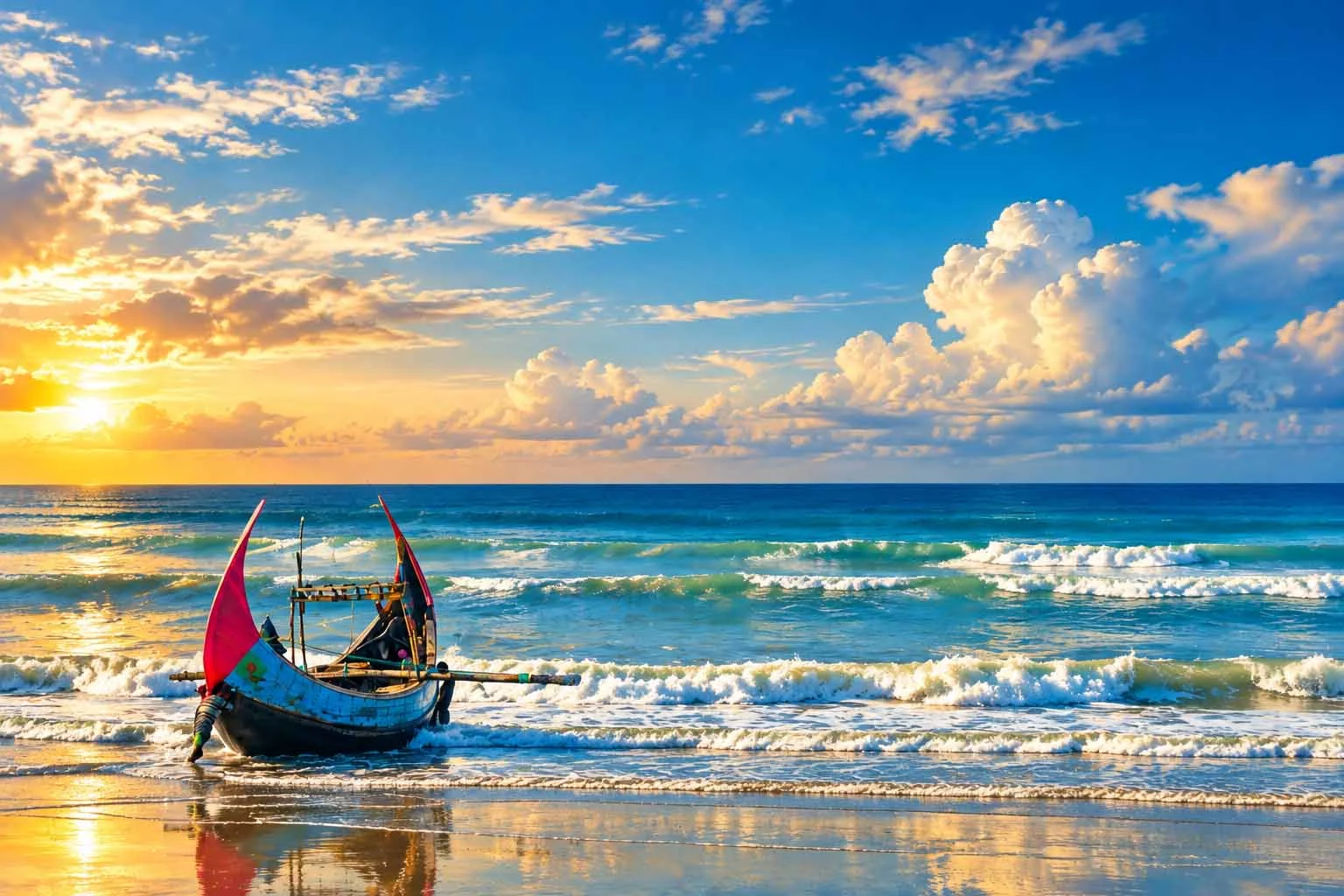
Cox’s Bazar- One of the longest natural beaches on Earth, best between November and February. Stay on the main tourist strip.
Heritage sites- Bagerhat’s Sixty Dome Mosque and Paharpur’s Buddhist monastery are both UNESCO World Heritage Sites, and both are often nearly empty.
Barisal and the south- river launches, floating markets and slow village life. Add Kuakata if you like beaches with room to breathe.
The northwest. Ramsagar’s centuries-old lake and Madhupur’s Sal forest make a quiet, rural loop few foreigners see.
Food. Bangladesh is a country you eat your way through. See our guide to traditional Bangladeshi food. For a longer list, read our Top 10 Places to Visit in Bangladesh and our guide to offbeat destinations.
✈️ Getting Around
Distances in Bangladesh are bigger than they look, and the roads are slow, especially around Dhaka. You have four main options:
• By air: short flights link Dhaka with Cox’s Bazar, Sylhet, and other cities, and save a day of road time.
• By rail: intercity trains are cheap and full of local life, though schedules slip.
• By river: overnight launches connect Dhaka with the south, including Barisal, and give you the best view of delta life.
• By car: a private car and driver give you the most freedom when you link several places.
🏨 Where to Stay
Dhaka has international-standard hotels with reliable air conditioning, Wi-Fi, and airport transfers, and it's the easiest base for the first and last nights. Outside the capital, the picture changes. In the Sundarbans and the haors, you sleep in private-cabin boats. In Srimangal, eco-lodges and tea-estate guesthouses put you among the gardens. In smaller towns, expect simple but clean rooms. Book early for winter, because the best places fill quickly between December and February.
💰 Money, SIM Cards and Power
The currency is the taka (BDT). Cards work in upscale hotels and a few city restaurants, while markets, village cafes, and rural stops want cash in small notes. ATMs are common in cities, so carry both. Your daily budget depends on your style.
SIM cards cost little and are sold at airport and city kiosks; registration requires your passport. Hotels and cafes offer Wi-Fi, but forests and wetlands often have no signal. Power is 220 to 240 volts, so pack a universal adapter.
🍛 Food and Water
Bangladeshi food is bold, fragrant, and built around rice, fish, and spice. Start with shorshe ilish (hilsa in mustard), kacchi biryani, bhortas, khichuri and pitha. Our guide to traditional Bangladeshi food covers fifteen dishes in detail.
New arrivals often get stomach trouble from tap water and street snacks. Stick to bottled or filtered water, avoid ice you cannot vouch for, and choose busy stalls that cook to order. We send guests only to kitchens we know well.
🏥 Health and Insurance
See a travel clinic six to eight weeks before you go. Ask about routine vaccines, typhoid, hepatitis A, and any other itinerary-specific advice. Some countries require proof of yellow fever vaccination for travelers arriving from risk areas, so check the rule for your route.
Dengue is present, especially after the rains, so use repellent and cover up at dusk. Pack a basic medical kit, and buy travel insurance that covers medical evacuation and your planned activities. Good hospitals are concentrated in Dhaka, so plan remote trips with a guide who knows the nearest clinic.
🛍️ Souvenirs and Tipping
Bangladesh makes beautiful things by hand. Look for handwoven cotton and muslin, jamdani saris, clay and terracotta pieces, nakshi kantha embroidery, brass work, and Srimangal tea.
Shop in markets and craft stores, bargain politely and agree on the price before you buy. Never buy anything made from wildlife, shell, or coral. Tipping is appreciated rather than required. A small tip for guides, drivers and boat crews is customary at the end of a trip, and restaurants often add a service charge.
🎉 Festivals and Holidays
Bangladesh keeps a lively calendar. Pohela Boishakh, the Bengali New Year, falls on 14 April and fills the streets with color. Eid, at the end of Ramadan, is the biggest family holiday, and cities empty as people travel home.
Durga Puja in autumn draws crowds and processions around Hindu temples. Friday is the main weekly day off, and many shops close around midday for prayers. Festivals are wonderful, but they affect traffic, prices, and hotel availability, so tell us if you want to travel around one, or avoid it.
🎒 What to Pack
Light, loose cotton or linen clothes; a modest cover for shoulders and knees; and comfortable walking shoes and sandals that slip off easily at mosques. Add a hat, sunscreen, repellent, a reusable water bottle, a power bank, and a universal adapter. In the monsoon, bring a thin rain jacket. For nature trips, add binoculars and muted greens and browns.
🤲 Etiquette and Dress
Bangladesh is mostly Muslim, and modesty matters. Wear loose cotton that covers your shoulders and knees, particularly near mosques and in villages. Take your shoes off at the door of any mosque or temple. Use your right hand for eating and passing things.
Open with a smile and a greeting, and wait to see whether a woman offers her hand. Ask permission before you photograph anyone, and be especially careful with women and children. If someone offers you tea, say yes, because it is a welcome and not a sales pitch.
🛡️ Is Bangladesh Safe?
Most travelers who visit with a guide and sensible planning have trouble-free trips, but conditions change, so read your government’s advice before you book. Here is where things stand as of mid-October 2026.
• Chittagong Hill Tracts: the UK government advises against all but essential travel to Rangamati, Khagrachari and Bandarban, and foreigners need prior government approval to visit. We do not currently include these areas in our itineraries.
• Insurance: The UK government notes that your travel insurance could be invalidated if you travel against its advice. Check your policy.
• Festivals: Durga Puja runs from 16 to 21 October 2026. Expect crowds around temples, extra security, and traffic disruption, and be aware of intercommunal violence during past festivals. Avoid large crowds and follow local advice.
• Flooding: flash floods and landslides affect parts of the country, including Sylhet and Cox’s Bazar. Check forecasts before you travel.
• Flights and fuel: conflict in the Middle East has disrupted flights worldwide, and Bangladesh has fuel shortages. Check with your airline and your tour operator.
• Everyday precautions: keep valuables out of sight, agree on prices before getting into a rickshaw, avoid walking alone late at night in unfamiliar areas, and ask your hotel to book trusted transport.
Roam Bengal tracks these advisories and will say clearly where we can and cannot take you. Women travelers should dress modestly, plan transport in advance, and consider asking for a female guide.
⚠️ Common Mistakes
The same few errors catch first-time visitors. Arriving without a visa plan and hoping the airport will sort it out. Cramming too many cities into one week, then spending half the trip in traffic. Underestimating how long even short distances take. Planning for winter weather in the monsoon. Eating from a random stall on day one. Skipping travel insurance. A bit of planning before you fly avoids all of them.
🗣️ A Few Words of Bengali
You will get more smiles with a few words. Say Assalamu alaikum to greet, dhonnobad to say thank you, and koto taka to ask the price. At the table, kom jhal means less spicy, and ar ektu means a little more. Locals will notice the effort and teach you the rest.
🧭 A Sample Seven-Day Route
This is a starting point, not a fixed plan. [Adjust the route to match your tours.] Book the Sundarbans first, because boat dates fill quickly in winter.
• Days 1 and 2, Dhaka: Old Dhaka’s palaces, Lalbagh Fort, Sadarghat, and a food tasting.
• Days 3 to 5, the Sundarbans: a private boat trip with rowboat rides, a watchtower and houseboat nights.
• Days 6 and 7, Sylhet: Srimangal’s tea gardens and Lawachara National Park, with a flight or drive back to Dhaka.
For other lengths, we can build a ten-day heritage loop or a nature trip through Tanguar Haor and Ratargul.
❓ Questions We Hear Before Every Trip
Do I need a visa?- Almost certainly yes. Apply in advance if you can. A visa on arrival is discretionary.
What is the best time to go?- October to March for most trips. The monsoon suits Ratargul and Tanguar Haor.
Is it safe for solo women?- Many women travel here, usually with a guide. Dress modestly and plan transport and accommodation in advance.
Will I see a tiger in the Sundarbans? Unlikely, and no honest guide will promise one. Expect deer, birds, crocodiles, fresh pugmarks and a lot of silent water.
Can I drink the tap water?- No. Stick to bottled or filtered water.
How many days do I need?- Seven days cover Dhaka, the Sundarbans, and Sylhet. Ten to twelve days lets you add heritage sites or the south.
What should I wear?- Wear loose cotton that covers your shoulders and knees, plus shoes that slip off easily.
Do I need a private guide?- You can travel independently, but the language barrier, traffic, and logistics are significant. A private guide saves time and avoids stress.
📩 Plan Your Bangladesh Trip
Tell us your dates, interests, and how adventurous you feel, and we’ll plan the route, arrange the paperwork, and meet you at the airport.
Book your private Bangladesh tour with Roam Bengal today.