Exploring Chittagong Tour
Uncover Bangladesh’s coastal gem! Explore majestic green hills, historic ship-breaking yards, serene beaches, and vibrant port culture with expert guides. Reserve your private port city escape!
A Private Journey Through Mangrove Forests, Ancient Temples & Southern Bengal
Southern Bangladesh moves at the pace of its rivers. Villages rise and fall with the tide, centuries-old mosques and temples stand quietly beside working farmland, and the world's largest mangrove forest spreads across the horizon just beyond the last paddy field. This 8-day private itinerary with Roam Bengal is built around that rhythm—it carries you through Khulna, Bagerhat, and the wider southwest, linking the wild Sundarbans with the UNESCO-listed mosque city of Bagerhat and the everyday cultural life of southern Bengal.
Much of the route runs along water. You will cross rivers by boat and by bridge, watch mangrove creeks narrow around a safari vessel, and walk through centuries-old brick monuments that UNESCO now protects. Along the way, communities whose livelihoods are still tied to the rivers, forests, and land open a window onto a Bangladesh that few visitors see.
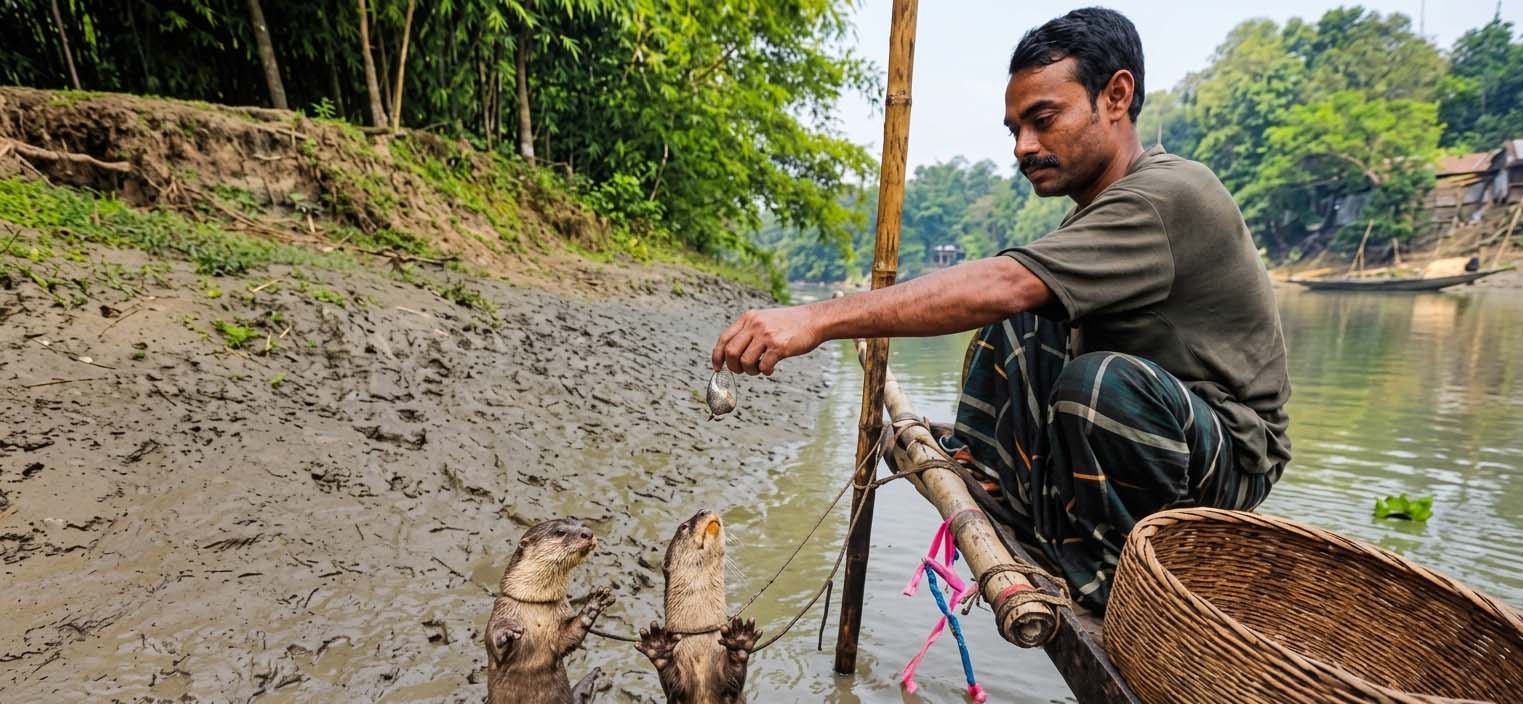
This is not a checklist of famous sites. Alongside well-known landmarks like the Sixty Dome Mosque, the journey makes room for quieter stories—a fishing family that still works with trained otters, a poet's riverside estate, a flower village in full bloom—the kind of detail that a shorter, faster tour tends to skip.
By the end of eight days, you will have moved through Sultanate-era architecture, colonial history, Liberation War memory, river culture, and untouched wilderness—a fuller picture of how people, nature, and history have shaped this corner of Bengal together.
Leaving Dhaka, the route soon settles into the open countryside of rural Bangladesh, crossing the Padma Bridge — a 6.15-km engineering landmark — on the way south.
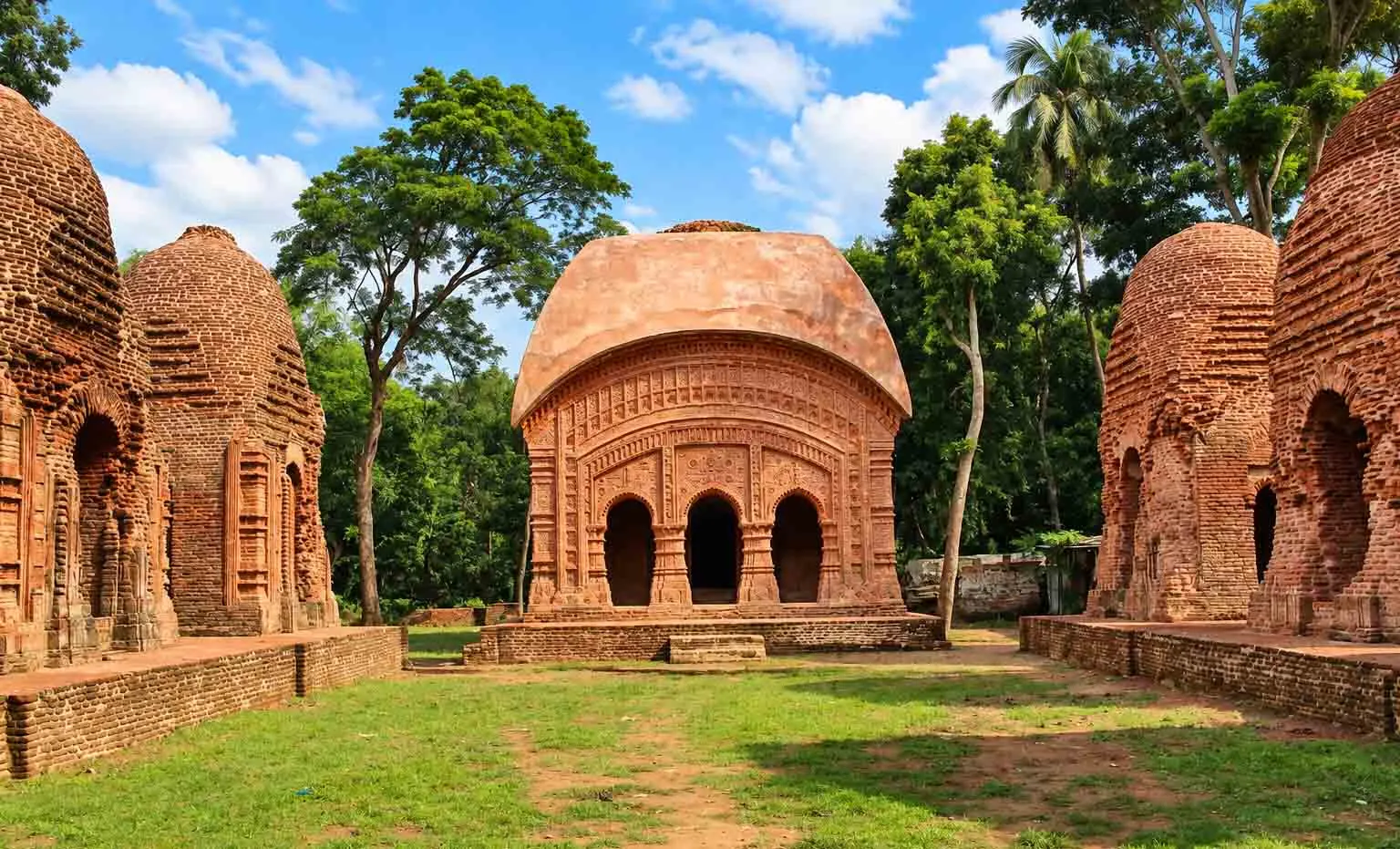
The first stop is the 15th-century Patrail Jame Masjid (also known as Dighirpar Masjid), a secluded Sultanate-era brick mosque reached through palm groves and quiet farmland. From there the road continues to Mathurapur Deul, a 16th-century Hindu temple tower whose terracotta reliefs are among the finest in the region. After lunch, the day includes a visit to the Mausoleum of Bangabandhu Sheik Mujibur Rahman at Tungipara, before arriving in Khulna by evening.
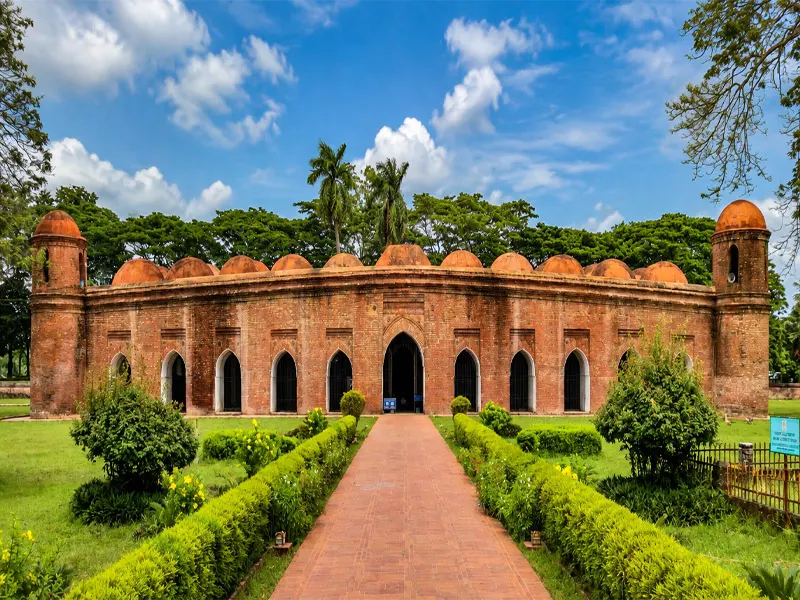
Today is centered on the UNESCO World Heritage-listed Historic Mosque City of Bagerhat. The Sixty Dome Mosque (Shat Gombuj Masjid) is the centerpiece. Despite its name, it actually has 77 low domes supported by 60 stone pillars and remains one of the finest examples of Sultanate-era architecture in Bengal. The Bagerhat Museum, on the same grounds, holds artifacts recovered from the site and is a useful stop for context before or after the mosque itself.
From there, visit the Shrine of Khan Jahan Ali, where sacred pond crocodiles and centuries of local folklore still draw pilgrims, and the nearby quieter Ajoddha Math (Kodla Math) temple. After lunch, the group returns to Khulna for a guided walk through the Divisional Museum.
An early transfer to Mongla Port leads to a full day aboard a private safari vessel inside the Sundarbans, the world's largest mangrove forest. Along quiet tidal creeks, keep an eye out for spotted deer, estuarine crocodiles, and — with some luck — Ganges or Irrawaddy river dolphins.
The boat stops at forest stations for guided walks along the boardwalks, with lunch served on board. The group returns to Khulna in the evening; this is a day cruise rather than an overnight stay inside the forest.
The morning is spent at Rabindra Kuthibari (the Dakkhindihi Complex), an estate associated with Rabindranath Tagore, followed by a visit to the nearby Eleven Shiva Temples (Egaro Shib Mondir).
In the river villages around Narail, a small number of families still practice otter-assisted fishing, working alongside trained otters to herd fish into their nets — one of the last places on earth where this method survives as an everyday livelihood rather than a display staged for visitors. The day ends with a transfer to Jashore.
The day opens at Godkhali, Bangladesh's flower-growing capital, where fields of marigold, rose and gladiolus stretch out for harvest. From there, continue to Modhupalli in Sagardari, the birthplace and ancestral home of poet Michael Madhusudan Dutta.
Nearby stand three lesser-visited Sultanate-era mosques — Nungola, Gorar and Golakata — before the drive continues to Kushtia for the night.
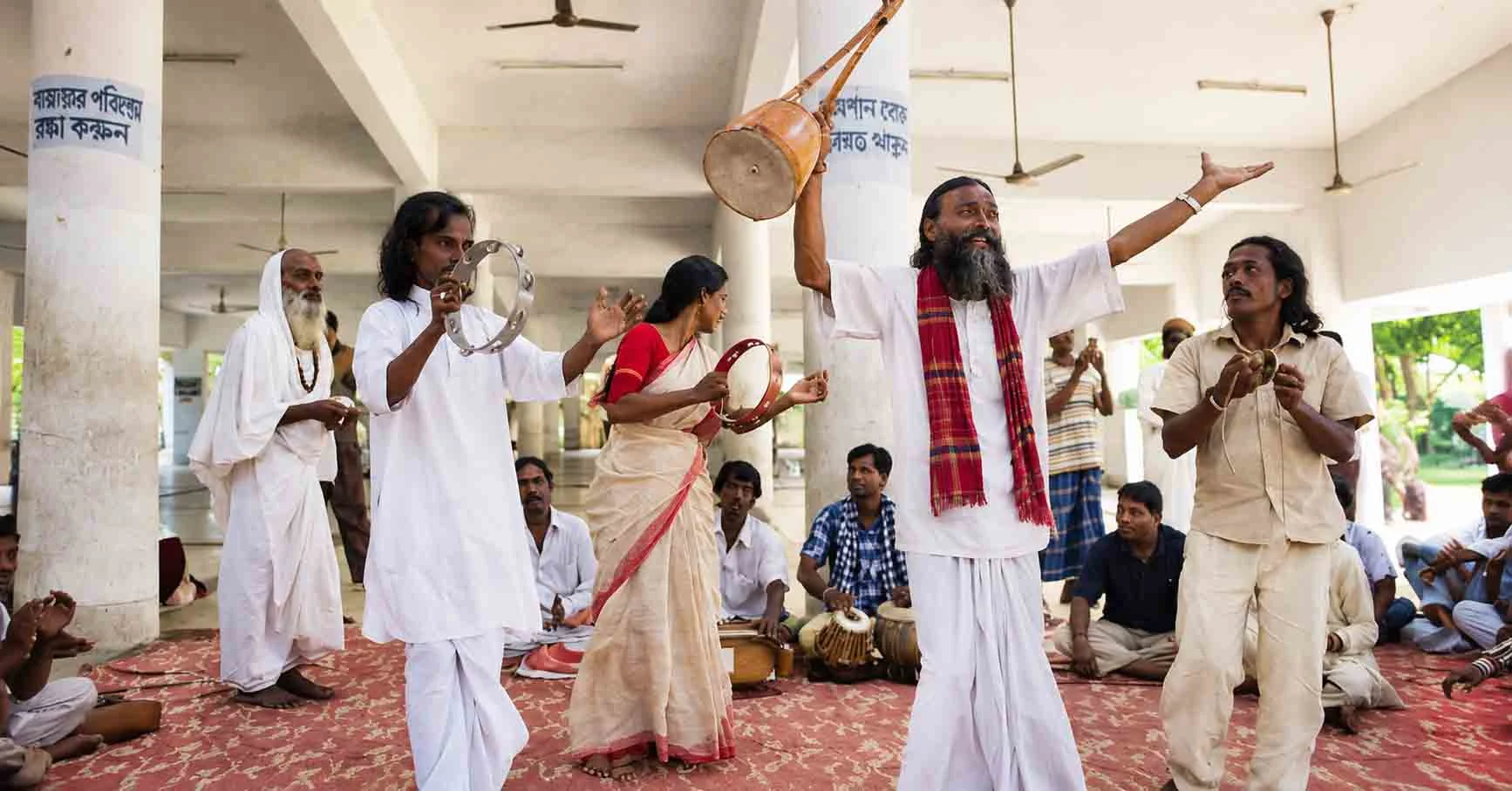
At Lalon Akhra, Baul musicians carry on a musical and philosophical tradition rooted in the teachings of Lalon Shah, whose mausoleum sits at the heart of the complex. Nearby, the Kangal Harinath Memorial Museum honors one of Bengal's early social-reformer journalists.
Later, Shilaidaha Kuthibari — Tagore's riverside residence — offers a quieter look at the landscape that shaped his writing, and the day closes with a boat ride on the Padma River at golden hour.
The day begins at Carew & Co., one of the subcontinent's oldest operating distilleries, established in 1938. From there, visit the Atchala Ghar in Karpashdanga, which is linked to the national poet Kazi Nazrul Islam.
At Mujibnagar, Bangladesh's provisional government formally took its oath in 1971 — one of the country's most significant sites of national memory. The day ends at Amjhupi Nilkuthi, the atmospheric ruins of a 19th-century indigo plantation.
The final day starts beside the Hardinge Bridge at Pakshi, with a viewpoint over the nearby Rooppur Nuclear Power Plant. From there, Daulatdia Ferry Ghat offers a last look at the everyday energy of river-crossing life in Bangladesh, before the drive back to Dhaka for an evening arrival.
📅 Start Days – Any day works, but Friday departures align best with the week's closure pattern (Carew & Co. and Mujibnagar Memorial are both closed Fridays, so those visits sit mid-trip instead).
🏨 Hotels – Local-standard 4–5★ (AC, hot water, western toilets) in Khulna, Jashore, and Kushtia; best available upscale option elsewhere.
🚤 Sundarbans Boat - – Private day-cruise vessel — solar lighting, western toilet, and standard safety equipment on board; certified wildlife guide included.
🐅 Wildlife – Tiger sightings are rare and can't be guaranteed; the mangrove creeks, birdlife, and overall biodiversity are the real highlight of the day.
📋 Permits – Sundarbans forest permits are required and arranged in advance (allow lead time); site entries elsewhere are subject to normal opening hours.
🌤️ Best Season – October–February is ideal (cooler, clearer skies); the Sundarbans is closed from June 1–August 31 for the wildlife breeding season, so trips can't include a safari during that window.
🍛 Meals – Bengali meals included as specified in the itinerary; vegetarian, vegan, or gluten-free needs can be arranged with advance notice.
👗 Dress Code – Shoulders, chest, and knees covered at mosques and shrines; a scarf (for women) and long trousers (for men) make these stops easier.
💵 Cash & Cards – Carry some small-denomination BDT for tips and incidentals; ATMs are available in Khulna, Jashore, and Kushtia.
📷 Photography – DSLR/mirrorless with a 300–600mm lens suits wildlife well; drone use is restricted in many areas and needs advance clearance.
🦺 Safety – Life vests are mandatory on all boat rides, no exceptions; the schedule can flex around weather or road conditions as needed.
🗺️ Off the usual circuit: – Beyond the well-known landmarks, the route makes room for a working otter-fishing family, a poet's riverside estate, and a flower-growing village that most Sundarbans trips never reach.
🚗 Fully private, fully flexible – Your own vehicle, guide and safari boat — no fixed groups, no shared schedule, and pacing that can adjust around your interests.
🧭 Four regions in one trip – Khulna, Bagerhat, Jashore and Kushtia are woven into a single loop, so you get mangrove wilderness, Sultanate architecture, Liberation War history and Baul folk culture without separate trips.
🛣️ Real local access – guides and drivers who know the back roads, prayer-time closures and seasonal quirks of each site, so the schedule actually holds up on the ground.
📚 Expert cultural context – Guides who can explain the Sultanate history behind the Sixty Dome Mosque, the Baul philosophy of Lalon Shah, and the folklore of Khan Jahan Ali — not just point at monuments.
🛏️ Comfort without compromise – private AC vehicle, well-reviewed hotels and a proper safari boat, so remote destinations don't mean rough travel.
🤝 Built on responsible travel – Fair pay for guides, drivers and host communities, and wildlife viewing that keeps a respectful distance — see the full pledge below.
Uncover Bangladesh’s coastal gem! Explore majestic green hills, historic ship-breaking yards, serene beaches, and vibrant port culture with expert guides. Reserve your private port city escape!
Step into a time machine! From Mughal forts in Old Dhaka to the modern pulse of New Dhaka, ride colorful rickshaws, cruise the Buriganga River, and savour authentic street food. Book your ultimate Dhaka day tour today!